
Campus tours
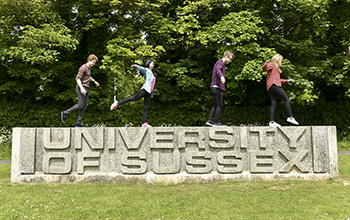
Join a campus tour this summer and get a feel for life at Sussex. With award-winning campus food, a National Park setting and buzzing Brighton on our doorstep, our location and facilities are hard to beat.
Book your visit
On campus - in person
You鈥檒l study for this degree on our campus, joining our academics and fellow students. With in-person contact time, digitally supported educational resources, library collections and independent study, this course is designed to give you an inclusive education. Your learning experience may also include work placements, field trips, studying abroad and internationalisation experiences.
Find out about our beautiful campus
Virtual tour
Want to learn more about life at Sussex?
Our 360掳 virtual tour has been designed to introduce you to life in our diverse, supportive and inclusive community. Join our students for an immersive experience as they reveal why Sussex offers a space to follow your passions, find your voice, and discover people and places that will inspire you.
Begin your tour

As a founding partner of ResearchPlus, a collaboration of research-focused universities, we engage with government, industry and civil society to support economic growth, prosperity and wellbeing across the whole of the UK.
Find out more
Modules
This is a joint-honours course, offering you a combinations of subjects, each taking up 50% of your time. Find out more from our guide to undergraduate study
-
 Silver
The student experience and student outcomes are typically very high quality.
Silver
The student experience and student outcomes are typically very high quality.
This rating was awarded in 2023, for four years.
Find out more about our approach to teaching and supporting you to thrive
-
Year 1 at Sussex
Your modules
Core modules
Core modules are taken by all students on the course. They give you a solid grounding in your chosen subject and prepare you to explore the topics that interest you most.
Autumn teaching
- Difference and Diversity: Humans and Beyond
- Human Geographies of the Modern World
- Making Sense of Humanity: Key Concepts in Anthropology
- The Geographer’s Toolkit 1: Reading, Writing, Research and Fieldwork
Spring teaching
- Geographies of Cities and Mobilities
- Making Money, Making Life: Capitalism, Care and the Environment
- The Geographer’s Toolkit 2: Maps and Stats
- Worlds and Selves
Your degree
In your first year, you’ll:
- learn about the history and development of geography and anthropology, and the relevance of these disciplines in the modern world
- explore the qualitative and quantitative skills, as well as analytical concepts important to both subjects
- discover how anthropologists analyse the dynamics of kinship and family life, and the world of work in the context of capitalism
- learn about the approaches taken by geographers to analysing cities and the forms of mobility important to them.
Hands-on fieldwork will bring your studies to life as you explore Brighton and the surrounding area.
Teaching
Teaching methods typically include lectures, seminars, one-on-one meetings, and other activities including film screenings.

 50%: Lecture
 40%: Seminar
 10%: One-to-one
Assessment
Assessment methods typically include essays and creative assignments, such as posters and reflexive writing, as well as some examinations.
Contact hours and workload
This year of study includes approximately 1,200 hours of work. This breaks down into about 180 hours of contact time and about 1,020 hours of independent study.
Engage and actively participate throughout your studies to get the most out of your course.
-
Year 2 at Sussex
Your modules
Core modules
Core modules are taken by all students on the course. They give you a solid grounding in your chosen subject and prepare you to explore the topics that interest you most.
Autumn teaching
- Ethnographic Research Methods
- Global Geographies of Economic Change
- Religion, Ritual & Global Transformation
- Understanding Global Migration
Spring teaching
Options
Alongside your core modules, you can choose options to broaden your horizons and tailor your course to your interests. This list gives you a flavour of our options, which are kept under review and may change, for example in response to student feedback or the latest research.
While it鈥檚 our aim for students to take their preferred combinations of options, this can鈥檛 be guaranteed and will be subject to timetabling. Options may be grouped and if so, students will be able to choose a set number of options from the selection available in any particular group.
Spring teaching
- Cities and Urban Lives
- Culture and Representation
- Environmental Perspectives on Development
- Ethnographic Field Research
- Geography Overseas Field Class
- Social Geographies
- Southeast England Field Class
- Visual Anthropology
Field trips
Get involved in fieldwork from the start of your course. You develop research, analytical and team-working skills in regions where our academics actively conduct research.
In Year 2, you can pick from an exciting range of locations: recent destinations include China, Greece, Marseille, Corsica, Las Vegas and the Mojave Desert. There is also a UK-based field trip.
Find out more about Geography field trips at Sussex
Your degree
In your second year, you’ll:
- cover the core areas of human geography and anthropology in-depth
- engage with approaches developed by scholars in both these connected disciplines to study global migration, economic change and transformation, politics, religion and identity
- have the opportunity to learn more about areas of geographical and anthropological expertise at Sussex including the study of visual anthropology, journalism and the media, urban life, culture and its representation, and the field of social geography.
There will also be opportunities for you to join field trips, internationally and in the UK.
Teaching
Teaching methods typically include lectures, seminars, one-on-one meetings, and other activities including film screenings.
 50%: Lecture
40%: Seminar
 10%: Practical
Assessment
Assessment methods typically include longer-form essays, and practical exercises such as learning diaries, multimedia projects and field research reports.
Contact hours and workload
This year of study includes approximately 1,200 hours of work. This breaks down into about 265 hours of contact time and about 935 hours of independent study.
Engage and actively participate throughout your studies to get the most out of your course.
-
Experience Year
Study abroad (optional)
Apply to study abroad – you’ll develop an international perspective and gain an edge when it comes to your career.
If your application to study abroad is successful, you’ll have to meet the academic requirements at Sussex and also at the partner university. Find out more about studying abroad as a Sussex student
Beautiful scenery, welcoming people, and unforgettable experiences, from the Barrier Reef to the Snowy Mountains. I’m so grateful for the opportunity!”James Johnson
Geography and International Development BA
Studied abroad in AustraliaPlacement (optional)
To help you gain experience and increase your employability, you can apply for an optional placement as part of your course. You’ll be responsible for applying for and securing your placement. Our dedicated careers team can provide you with information and advice. If you’re successful in obtaining a placement, this will form part of your course.
Find out more about placements and internships
Please note that if you鈥檙e receiving 鈥� or applying for 鈥� USA federal Direct Loan funds, you can鈥檛 transfer to the version of your course with an optional study abroad period in any country or optional placement in the USA if the number of credits for the placement/internship exceeds 25% of the total credits for your course. Find out more about American Student Loans and Federal Student Aid
-
Year 3 at Sussex
Your modules
Options
You choose options to broaden your horizons and tailor your course to your interests. This list gives you a flavour of our options, which are kept under review and may change, for example in response to student feedback or the latest research.
While it鈥檚 our aim for students to take their preferred combinations of options, this can鈥檛 be guaranteed and will be subject to timetabling. Options may be grouped and if so, students will be able to choose a set number of options from the selection available in any particular group.
Autumn and spring teaching
Autumn teaching
- Advanced Sustainable Development: Sustainability in Policy and Practice
- Anthropology in the World: Theory, Knowledge, Action (and back again)
- Decolonial Movements
- Disasters, Environment and Development
- Geographies of Money, Finance, and Debt
- Global Work Experience
- Living Geopolitics: Re-Thinking the World (Dis) Order
- Mobilities and Global Inequalities
- Slavery, Emancipation and Legacies
Spring teaching
- Class, Community, Nation
- Critical perspectives on home
- Development, Business and Corporate Social Responsibility
- Embodied Minds: Culture, Politics, and Psychotherapy
- Ethical Worlds
- Global Food Security
- Global South Asia
- Political Ecology and Environmental Justice
- Race, Ethnicity and Identity
Your degree
The final year is all about flexibility.
You’ll shape your degree by choosing from a range of advanced specialist subjects in anthropological and geographical research. Our research focuses on global challenges relating to the environment, development and food security, human rights, geopolitics, violence and armed groups, slavery and inequality, death and dying, mobility, refugees and inequality, and ethics.
You may also undertake a research project and explore your own interests through the lens of anthropological debate.
Teaching
Teaching methods typically include interactive workshops, and one-to-one meetings where staff and students discuss specialist topics.
 80%: Practical
20%: One-to-oneAssessment
Assessment methods typically include dissertations and creative portfolios. Some students will complete an extended research-based thesis.
Contact hours and workload
This year of study includes approximately 1,200 hours of work. This breaks down into about 130 hours of contact time and about 1,070 hours of independent study.
Engage and actively participate throughout your studies to get the most out of your course.
Spirit of Sussex Award
Feel involved in life at the University, make friends and enrich your experience with us 鈥� the Spirit of Sussex Award is our way of recognising your extracurricular and voluntary achievements.
-
Video transcript
Hi everyone! As I'm sure you've all heard by now, the Spirit of Sussex Award is now live.
Students across the Sussex community are already earning their points
What will you do to earn yours?
There's so many ways to get involved.
Head over to the website to start your Spirit of Sussex journey.
Text: The Spirit of Sussex Award is an exciting new programme designed to recognise and celebrate the things you do outside your course.
Participating in the Award makes it easy and fun for you to get involved and make the most of university life.
We regularly review our modules to incorporate student feedback, staff expertise, as well as the latest research and teaching methodology. We鈥檙e planning to run these modules in the academic year 2026/27. However, there may be changes to these modules in response to feedback, staff availability, student demand or updates to our curriculum. We鈥檒l make sure to let you know of any material changes to modules at the earliest opportunity.
We鈥檒l do our best to provide as much optional choice as we can, but timetabling constraints mean it may not be possible to take some module combinations. The structure of a small number of courses means that the order of modules or the streams you choose may determine whether modules are core or optional. This means that your core modules or options may differ from what鈥檚 shown here.
Our experts
I have used my research to inform the World Bank and UN climate policy. I bring that real-world experience into the classroom to equip students with the practical tools and conceptual understanding they need to shape climate action and sustainability.”Professor David Ockwell
Professor of Sustainability and International Development
Anthropology

Geography
Prof David Ockwell
Professor of Sustainability andInternational Development
Prof Divya Tolia-Kelly
Professor of Geography and Heritage Studies
Careers
- 86% of Sussex undergraduates have completed work experience by the end of their course (亚洲情色 Career Readiness data at point of graduation 2023/24)
On our Geography and Anthropology BA, you develop cultural awareness as well as research, numerical, analytical and resource-management skills. This means you can go on to careers in a wide range of sectors, including:
- international development and environmental conservation
- civil service and government
- media and journalism.
Throughout your degree, you will receive support from your department and the university careers and employability centre, and can attend specialist careers events and workshops.
Where do our graduates work now?
Surveyed 15 months after finishing their courses, our recent graduates from the Department of Geography worked for employers including:
- .
And our recent graduates from the Department of Anthropology worked for employers including:
- .
( 2017-2022)
Working while you study
Our Careers and Entrepreneurship team can help you find part-time work while you study. Find out more about career development and part-time work
I wrote my dissertation about responsibility for workers in the garment industry and interned at Oxfam, leading me to work at the ETI.”Amelia Glynn
Business Adviser at the Ethical Trading Initiative
Design your future at Sussex
Taking the next step in your career can feel daunting, but we鈥檒l help you to explore, connect and flourish throughout your studies and beyond.
As a Sussex student, you鈥檒l learn how to tackle real-world challenges and have access to tailored programmes of careers support:
- our Career Lab helps you to explore your options, build key skills and connect with employers. Take part in internships, community consultancy projects and insight visits, where you can learn about life at organisations such as Brighton & Hove Albion Football Club, the Knepp Rewilding Project, and fashion brand Puig
- one-to-one appointments with your Faculty Careers Consultant can enable you to identify your career goals, write an effective CV and prepare for future interviews
- entrepreneurship initiatives like StartUp Sussex and Ideas Lab can empower you to turn your concepts into reality.
Explore how our Careers and Entrepreneurship team can support you
-
 Winner
Entrepreneurship Catalyst Award
Winner
Entrepreneurship Catalyst Award
-
 Winner
Supporting Student and Graduate Employability Award
Winner
Supporting Student and Graduate Employability Award
-
 Top 50
Best Universities for Work Experience in the UK
Top 50
Best Universities for Work Experience in the UK
Entry requirements
This course is available in Clearing
CCall our Clearing hotline 01273 007825 to explore your options and speak to our specialist teams. Our phone lines are open Monday to Friday 9am to 5pm BST. You can also apply for this course online now.
Apply online for this course
Fees
Note that your fees, once they鈥檙e set, may be subject to an increase on an annual basis. Find details on our Tuition fees page.
Home students
拢9,790 per year
Channel Islands and Isle of Man students
拢9,790 per year
On 19 March 2026 the UK Parliament set out that the tuition fee cap for 2026 entry will be 拢9,790. As the 亚洲情色 keeps fees for Home students and Channel Islands and Isle of Man students in line with UK Government-approved levels, fees will be 拢9,790 in 2026. In line with our terms and conditions, the University charges fees at the maximum levels set by the UK Government.
International students
拢27,300 per year
Study abroad
Find out about grants and funding, tuition fees and insurance costs for studying abroad
Placement
Find out about tuition fees for placements
Additional costs
Note about additional costs
Additional costs to your tuition fees may include field trips, equipment, materials, bench fees or studio hire. These costs are best estimates based on current market values which we review each year. These costs may be subject to change due to unforeseen circumstances where the University has limited control such as a change in a service provider or government guidance. We will let you know at the earliest opportunity if there is any change to these costs. We will also tell you if these costs are mandatory for passing your course or optional. Find out how to budget for student life.
Field trips
This course may involve optional excursions, such as one-day museum visits or field trips. Where possible, these are subsidised by the University.
Field classes
On this course, all students go on assessed field classes. You may opt for a 30-credit overseas field-class in the second year of this course. Locations change every year but recent destinations have included Dubai, the USA, China and Greece. Students pay for their airfares, while transfers, meals and accommodation are partly subsidised. Prices vary but the total cost to students usually ranges from 拢500 to 拢1,500. An initial deposit of 拢150 is required by semester 2 of year 1 for all overseas trips.
Alternatively, you can attend a 15-credit Southeast England field-class, which is subsidised by the University and free for students.
Living costs
We know the rising cost of living is on everyone鈥檚 mind, and affects us all in different ways. Our guide to living costs has been designed to help you plan and budget for life as a Sussex student.
Learn more about typical living costs
Scholarships
Our goal is to ensure that every student who wants to study with us is able to regardless of financial barriers, so that we continue to attract talented and unique people.
-
Chancellor's International Scholarships
£5,000 in the first year of full-time study
-
Climate Leaders Scholarship
£3,000 cash per year of full time study.
Scholarships recipients will be supported to develop a high level project plan and provided with mentoring support.
-
Sanctuary Scholarship (Undergraduate)
- Full 'Overseas' tuition fee waiver
- £16,440 per year of undergraduate study (up to 4 years)
- Sussexsport membership
- Guaranteed continuation of housing
-
Sussex Bursary
£1,000 in your first year of study (either Year 1 or Foundation Year).
£500 in your subsequent years of study.
-
Sussex Pakistan Scholarship (Undergraduate)
£4,000 discount on the first year of tuition fees
-
Sussex Türkiye Scholarship (Undergraduate)
£4,000 discount on the first year of tuition fees
-
Undergraduate Enrichment Award
£6,000 over 3 years of study
Contact us
Ask a student
Chat to Sussex students online via the UniBuddy chat platform.
Prospectus
What do you want to do next?



Legal information
We understand that deciding where and what to study is a very important decision. We鈥檒l make all reasonable efforts to provide you with the courses, services and facilities described in this prospectus. However, if we need to make material changes, for example due to government or regulatory requirements, or unanticipated staff changes, we鈥檒l let you know as soon as possible.