Your future career
Discover where a Computer Science and Artificial Intelligence degree could take you.
Explore how the intelligent systems driving our digital age can help us tackle the world’s most urgent challenges.
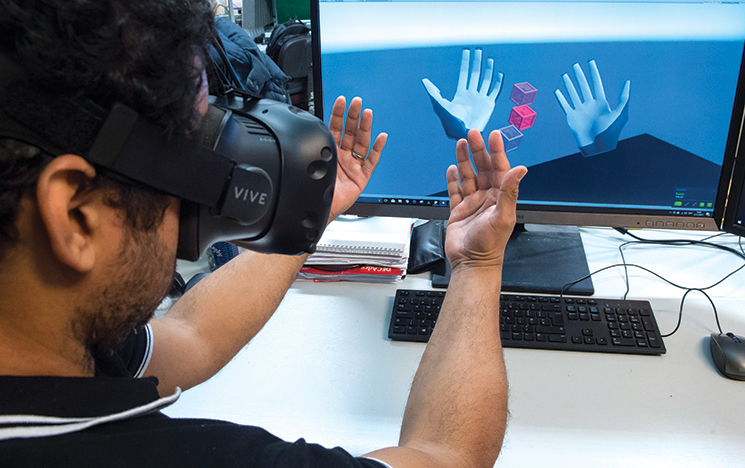
From the first intercontinental computer link to today’s research in bio-inspired computing, artificial intelligence (AI) has long been part of the Sussex DNA.
We combine deep technical expertise with a distinctive interdisciplinary approach – bringing together computer science, machine learning and adaptive systems to transform knowledge, technology and society.
As a Sussex student, you will:
Your learning experience will be underpinned by insights rooted in natural and artificial intelligence, and support you to develop a strong technical foundation.
Depending on your chosen course, you may have opportunities to draw on related disciplines that reflect our interdisciplinary approach to understanding intelligence, such as:
Your teaching will be influenced by our collaborative research community, which brings together expertise from across the University, including:
You’ll graduate with the skills, knowledge and confidence to develop creative solutions for tomorrow’s technologies, and to shape how they’re used in the world.
Our courses could be a great fit if you’re interested in how ethical, human-centred AI connects with areas including:
If you’re interested in digital media, you can also explore courses that harness specialist applications in the creation and communication of multimedia content.
For over 60 years, Sussex has played a vital role in developing artificial intelligence as both a tool and field of study. In 1974 we established a groundbreaking interdisciplinary programme that would become our School of Cognitive and Computing Sciences (COGS), which is widely recognised as one of the birthplaces of modern AI.
Key figures in our legacy have included the renowned philosophical psychologist Margaret Boden and then-postdoctoral researcher Geoffrey Hinton, who was later awarded the 2024 Nobel Prize for his work in machine learning.
Today, this legacy continues through the work of our research centres such as our Centre for Cognitive Science, Sussex Digital Humanities Lab and Sussex AI, and is embedded in the everyday life of the University through our seven principles for the use of AI in education.
Explore all Sussex has to offer with our range of on-campus and online Open Days, events and campus tours.
Book an Open Day place
Discover where a Computer Science and Artificial Intelligence degree could take you.
Computer Science and Informatics research at Sussex.
Learn about our researchers’ prototype for the world’s first large-scale quantum computer.
Explore how Artificial Intelligence MSc student Shuaib is using AI to improve patient care.
Learn how we’re understanding how computers interpret the world around us.
Want to learn more about life at Sussex?
Our 360° virtual tour has been designed to introduce you to life in our diverse, supportive and inclusive community. Join our students for an immersive experience as they reveal why Sussex offers a space to follow your passions, find your voice, and discover people and places that will inspire you.
Begin your tour
Find out more about fees, funding and student budgeting.
Uncover everything that Brighton has to offer – our city by the sea.
Take a look at our accommodation options, both on and off campus.